ZWO FF130 APO review: two years with two telescopes
Two FF130s, two ASI2600MM Pro cameras, and roughly two years of unmanned nights in a remote Spanish observatory — plus our first measured star-quality data. Here's what living with them has actually been like, including the bits we haven't solved.
BeyondBackyard — published 11 October 2026 by AstroPhilth & Jamie (BackyardSpaceDude). Award links to be added once verified.


Most telescope reviews are written after a few weekends. This one is written after hundreds of unattended nights. We bought our first ZWO FF130 because the combination of a 1,000mm focal length, promised sharpness and price looked unusually compelling. When Jamie and I decided to establish a remote observatory in Spain and could have chosen almost anything, we bought a second one.
That decision probably says more about our confidence in the first telescope than any specification sheet. But two years has also exposed the practical realities of running big refractors: their weight, the patience f/7.7 demands on faint targets, a dual rig that doubles as a sail, and one bright-star scattering artefact we still can't explain. We've also spent September 2026 taking proper measurement subframes, so this review includes our first quantitative star-quality data — with all its limits made explicit.
Disclosure
Both telescopes were owner-purchased through The Widescreen Centre, who were genuinely helpful while we built the remote setup. This is an independent owner review: no sponsorship, loan or affiliate arrangement.
What is the FF130?
The ZWO FF130 APO is a 130mm air-spaced quadruplet apochromat with the field correction built into the optical design — a “flat-field” astrograph. At a nominal 1,000mm and f/7.7 it sits in the serious deep-sky sweet spot: long enough for galaxies and small nebulae, slow enough to be demanding on the faintest targets. Because the corrector is integrated, native focal-length imaging needs no separate field flattener and no fixed flattener-to-sensor spacing to chase. You still need adequate focus travel and a mechanically square train, and ZWO's optional 0.7× reducer is a separate product with its own spacing requirements.
| Specification | Figure | Source |
|---|---|---|
| Aperture | 130mm | Manufacturer |
| Native focal length | 1,000mm (nominal) | Manufacturer |
| Focal ratio | f/7.7 | Manufacturer |
| Optical design | Air-spaced quadruplet APO, integrated field correction | Manufacturer |
| Advertised image circle | 60mm — we have not tested full-frame | Manufacturer/retailer |
| OTA weight | 12.5kg | ZWO official product page |
| Our cameras | ZWO ASI2600MM Pro, 26MP APS-C, 3.76µm, 16-bit | Manufacturer |
| Our image scale | ~0.776 arcsec/pixel at 1,000mm | Calculated |
Why we bought it — then bought another
Our imaging story starts in the COVID-19 lockdown, when Phil (Astrophilth) first pointed a camera at the night sky. Since then we've worked through a William Optics 103ED, Sky-Watcher Quattro 8- and 12-inch Newtonians, two Celestron EdgeHD 8s and a Rokinon 135mm — a proper tour of the astrophotography greatest-hits catalogue. The FF130 stood out for offering 1,000mm and the promise of crisp, flattener-free images at a price that undercut comparable alternatives. We also liked the idea of ZWO's support behind it, since much of our existing kit was already ZWO.
The first impression was memorable: a stout flight case, everything snug in cellophane, threaded adapter rings stepping the native aperture down to M42, and that white tube with red-anodised rings, cap and dew shield. We were early adopters — we believeour first unit may have been the first FF130 sold in the UK, but we can't prove that, so treat it as a nice story rather than a claim. The red-and-white theme eventually carried through our entire dual build, because if you're going to build a two-telescope rig you may as well coordinate.
When Jamie and I teamed up to rent a pier at a remote Spanish facility, we racked our brains about what to install — and kept coming back to the data already coming off the first FF130. We bought a matching second rather than change designs. Both came from The Widescreen Centre, who were incredibly helpful as we planned the remote setup — the kind of help you remember when a mount full of glass is sitting in pieces on your living room floor.
First light wasn't perfect — but the FF130 wasn't the culprit
Our early experience included a genuine head-scratcher. Rather than ZWO's own optional reducer, we fitted a Starizona Apex ED 0.65× and began seeing triangular stars. Nothing makes you question your optical train quite like stars with corners. The obvious suspicion was pinched optics in the telescope itself.
We took real subframes to the Practical Astronomy Show and discussed them with ZWO representatives there. Once they understood we were using a third-party reducer, they suggested testing with it removed. The triangular shapes disappeared at native focal length, and both scopes have run native ever since.
That's an A/B observation about ourcombination, not a verdict on the Starizona product or on FF130s generally — we can't say the reducer is universally incompatible, and the FF130 optics were never pinched. But it taught us to appreciate the design's quiet virtue: at native 1,000mm there is no flattener spacing to get wrong. Sometimes the best backfocus calculation is the one you don't have to do.
What the stars actually look like
Across two years of LRGB and narrowband work, both scopes have consistently delivered crisp, round stars to the corners of our APS-Csensors, with no material colour fringing that we've noticed. Our two copies perform remarkably similarly — a flat-frame pattern difference between them aside (we suspect filters rather than optics, but haven't isolated it). What we can't tell you is how an FF130 behaves at full frame: we don't own a full-frame camera, and we won't pretend our experience proves ZWO's advertised 60mm image circle.
In September 2026 we finally put numbers where our anecdote was: matched, calibrated, unregistered subframes of the Cave Nebula (Sh2-155) from both telescopes, measured in PixInsight's SubframeSelector at our true image scale (0.7756 arcsec/pixel, 16-bit, gain 0.076 e⁻/DN).
Median whole-frame results, 180-second subs, September 2026:
| Filter (night) | Scope | Subs | Median FWHM (px) | Median FWHM (arcsec) | Median eccentricity |
|---|---|---|---|---|---|
| L (8 Sep) | Left | 5 | 2.47 | 1.92″ | 0.361 |
| L (8 Sep) | Right | 5 | 2.44 | 1.89″ | 0.353 |
| R (11 Sep) | Left | 3 | 1.84 | 1.43″ | 0.507 |
| R (11 Sep) | Right | 3 | 1.72 | 1.33″ | 0.467 |
| G (11 Sep) | Left | 3 | 2.19 | 1.70″ | 0.502 |
| G (11 Sep) | Right | 3 | 1.57 | 1.22″ | 0.406 |
| B (11 Sep) | Left | 3 | 2.09 | 1.62″ | 0.415 |
| B (11 Sep) | Right | 3 | 1.88 | 1.46″ | 0.420 |
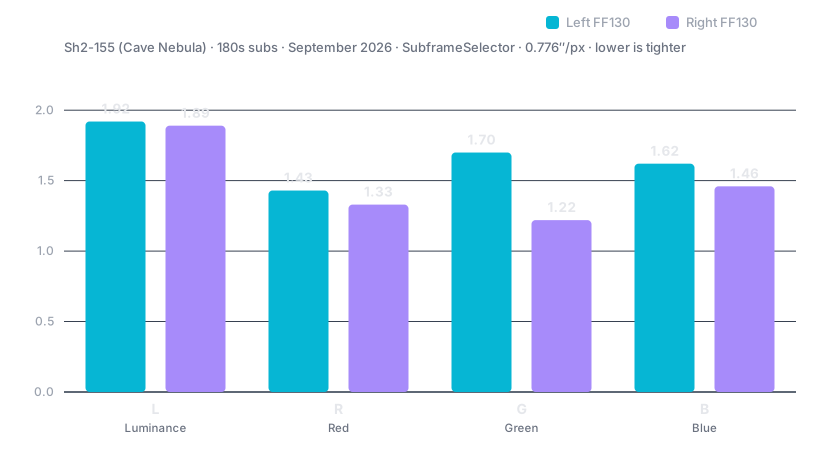
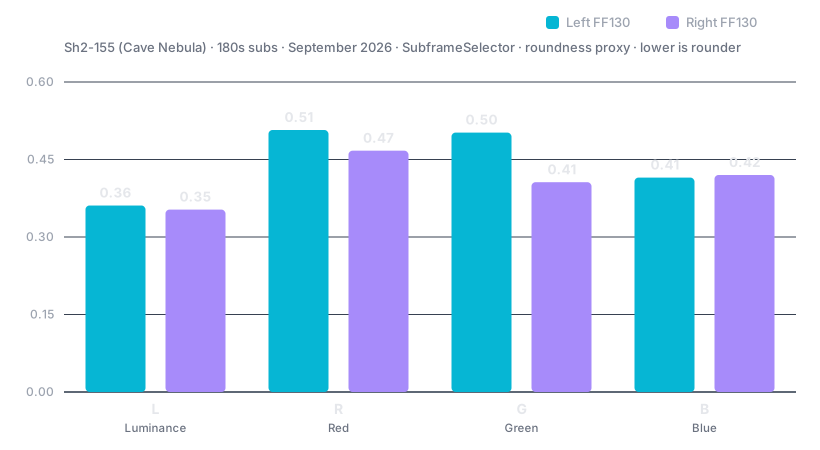
The Right scope measured slightly tighter on this run; we wouldn't read a systematic quality gap into one night per filter. The plan from here is per-region (centre/edge/corner) FWHM maps and an OIII/SII wavelength check as the dataset grows — see How we tested.
The bright-star scattering mystery
Now the honest bit. During our Orion-to-Horsehead mosaic — almost 20 panels at 1,000mm — we noticed a strange scattering of light creeping in from one side of the frame, almost diffraction-like. It was not a processing artefact: it appeared in individual, unstacked, unprocessed subs across roughly a week of data.
The pattern was consistent across all four LRGB filters, appeared in the same region of the frame on both optical trains, moved when the rotator angle changed, and turned up when a very bright star sat just outside the frame. Crucially, we have not seen it in H-alpha; OIII and SII remain unchecked as we write this.
A reflection somewhere in the train, a filter interaction, baffling, the camera — any of these could be involved. Two identical artefacts in matched instruments hint at common geometry rather than a one-off defect, but we have not isolated the cause, so we are not blaming the FF130's optics. If you know what causes this sort of thing, our inbox is open. We simply think a review should show its awkward results, not quietly omit them.
Remote nights: focus you can trust, wind you can't ignore
Both scopes focus with ZWO EAF motors under NINA. During installation we measured backlash and set compensation to 0 in / 40 out, and since then the focusers have simply worked: smooth, consistent autofocus curves, no slipping, no jamming, no servicing in two years. Filter focus offsets between LRGB and narrowband are modest and stable (roughly 20–120 EAF steps across the wheel, varying a little between the two focusers), which keeps filter changes painless.
We're deliberately demanding about focus: NINA watches a rolling five-frame sample and triggers a refocus on a 10% HFR rise (HFR is NINA's star-size metric; it isn't the same as FWHM). On a typical night that means around ten refocus runs after the initial routine. That's our chosen threshold, not a fault of the telescope — your cadence will depend on your conditions and tolerance. A focus curve, we've learned, tells you as much about the night as it does about the scope.
Wind is the other operational reality, and it's a property of our installation, not the OTA. Two big white tubes side by side make a surprisingly effective sail. Monitored through the observatory's ASCOM Alpaca weather interface, our twin FF130s on the Paramount ME show slight trailing and egg-shaped stars in 900-second exposures once sustained winds or gusts reach about 13 km/h. A single, lighter FF130 on a different mount may behave very differently — please don't treat 13 km/h as anyone's rated limit.
Size, build and handling
You know that childhood feeling of seeing a professional telescope and thinking that's a big telescope? Collecting the FF130s brought it right back. These are substantial tubes; we have never installed one single-handedly, at home or in Spain — two people protects the glass and the backs. If you have back problems or dream of a quick portable rig, factor this in seriously.
Once installed, the mass feels justified. The stock rings, dovetail and fittings have never loosened or slipped, and everything still looks the part in that anodised red. Aligning the pairto point at the same place is a separate challenge: neither OTA has needed optical collimation, but the adjustable saddles we use for tandem mounting sit slightly under capacity for the loaded weight, so relative pointing drifts and gets re-aligned around each full Moon. That's our saddle choice, not stock ZWO hardware — the FF130s themselves have been boring in the best possible way.
Two years of maintenance
At our most recent in-person inspection in July 2026— the fourth visit since installation — both scopes looked almost new. Southern Spain's dark skies come with Saharan dust, so we protect the objectives with Deep Sky Dad flip-flat panels when not imaging and park horizontally to limit what settles on the glass. It mostly works.
The July visit found dust on the front optics but no visible internal contamination in either scope, and no detectable imaging degradation before cleaning. We cleaned with Pancro lens solution and microfibre — what we happened to use, not an official optical-cleaning recommendation. The anodising, paintwork, rings and focusers still looked and felt excellent.
The one surprise residents: spiders had moved into the dew shields. Apparently we're not the only ones fond of these telescopes.
What we've captured
A telescope earns its keep in the data. Two years in, the detail and contrast coming off both FF130s keep rewarding the processing time — and our gallery records at the observatory log the site as Bortle 1, which certainly helps the faint stuff.
WR 134, the ring nebula in Cygnus, is a personal highlight and was, we're told, awarded AAPOD; Jamie's M82 (Cigar Galaxy)took an Image of the Day award and is, in our admittedly biased view, among the most detailed amateur versions of that galaxy we've seen. [VERIFY before publication: award names, dates, links and image credits; the WR 134 story deserves its own article.]
We've also undertaken an Orion-to-Horsehead mosaic requiring almost 20 panels at this focal length — a project that teaches you patience at 1,000mm like nothing else.
At f/7.7, the trade is integration time on faint targets. Our answer is the dual rig: two matched f/7.7 systems on the same target gather data at roughly twice the rate, which under idealised, matching assumptions works out near the signal-per-unit-time of a single f/5.4 system. To be clear about the physics: the scopes do not become f/5.4 — each stays 1,000mm f/7.7, and the gain is acquisition throughput, not focal ratio or field of view.
How we tested — and the limits of our testing
Observed over ~2 years: star shape and colour correction across hundreds of LRGB/narrowband sessions; focuser behaviour; mechanical stability; dust and finish condition across four in-person inspections.
Measured (September 2026): 22 calibrated, unregistered 180s subframes of Sh2-155 — five luminance per scope (8 Sep) and three each R/G/B per scope (11 Sep) — analysed in PixInsight SubframeSelector at 0.7756 arcsec/pixel, 16-bit, gain 0.076 e⁻/DN. Luminance pairs and RGB pairs were taken minutes apart, so both scopes saw near-identical conditions per filter. Whole-frame FWHM and eccentricity values are in the table and charts above; 3×3 corner mosaics accompany this section.
Limits, plainly stated:
- Whole-frame FWHM includes seeing, guiding, focus and wavelength — it is not a laboratory optical test.
- Sample sizes are small (3–5 frames per cell); we report medians, not fits.
- Luminance and RGB were taken on different nights, so cross-filter comparisons carry that caveat.
- Per-region corner numbers and OIII/SII wavelength checks are pending.
- Full-frame performance: untested. Our claims stop at the APS-C frame.
- Bright-star scatter: cause unresolved; OIII/SII unchecked.
Who should buy it — and who should pass
Consider the FF130 if you want a sharp, flat native field at 1,000mm; you image from a fixed or semi-fixed setup; you value trustworthy automated focusing; and you can handle — or get help handling — a genuinely large optical tube.
Think twice ifyou set up alone at remote dark-sky sites, your mount is modest, huge wide fields are your main interest, or you expect fast faint-target acquisition from a single scope. The FF130's price is only part of the system cost: mount, pier, handling and integration time all scale with it.
What we'd change:honest niggles rather than demands — the mass (inevitable at 130mm quadruplet, but worth saying), and we'd love to see ZWO publish more baffling/stray-light documentation to help owners diagnose reflections like ours.
Our verdict after two years
We've lived with two FF130s long enough to know both their quirks and their strengths. The native APS-C correction — now backed by our own measurements — the consistent autofocus, the secure rings and the durable finish have made them dependable remote workers. We won't gloss over the weight, the f/7.7 patience tax, or the bright-star artefact we've yet to explain, and our wind threshold applies to our rig and no one else's.
But there's a reason we went from one FF130 to two: we liked what came off the first, and we've kept liking what comes off both.
FAQ
Does the FF130 need an external field flattener?
No — at native focal length the flat-field correction is built into the optics, so there's no fixed flattener-to-sensor spacing to calculate. You still need correct focus and a mechanically square train, and ZWO's optional 0.7× reducer is a separate product with its own spacing requirements.
How is it on APS-C?
In our two-telescope, measured experience, excellent: stars stay compact to the corners and our two copies measure within fractions of an arcsecond of each other. All our quantitative evidence is APS-C.
Is it suitable for full-frame?
ZWO advertises a 60mm image circle, but we haven't tested full-frame and can't vouch for edge performance from firsthand evidence. If full-frame matters to you, seek out measured full-frame reviews.
Is f/7.7 too slow?
It's demanding rather than too slow. Faint structures need longer integration than a faster scope under the same sky. Our mitigation is a Bortle 1 site and two telescopes; under light pollution, plan your targets accordingly.
Is it portable?
It's movable, not portable in the grab-and-go sense — a ~12kg-class OTA plus accessories, best handled by two people. We regard it as a fixed-instrument telescope that can travel, not the reverse.
Do two f/7.7 telescopes become f/5.4?
No. Two FF130s remain two f/7.7 telescopes. Combining their data on one target roughly doubles acquisition rate — an idealised signal-to-noise advantage similar to f/5.4 — without changing focal length or field of view.
Review basis: approximately two years' independent ownership of two owner-purchased FF130s in a remote Spanish observatory, plus a September 2026 measurement session. AstroPhilth & Jamie (BackyardSpaceDude) · 11 October 2026 · Award links to be added once verified. Manufacturer specifications from ZWO's official product page and retailer listings recorded 11 October 2026; prices and lineups change, so check current sources.
BeyondBackyard Blog
New imaging projects, reviews, builds and print releases — delivered to your inbox.
No spam, unsubscribe anytime. We respect your dark skies.
Comments
Comments are not yet configured. Set NEXT_PUBLIC_GISCUS_REPO and NEXT_PUBLIC_GISCUS_REPO_ID to enable Giscus.
Read next
All posts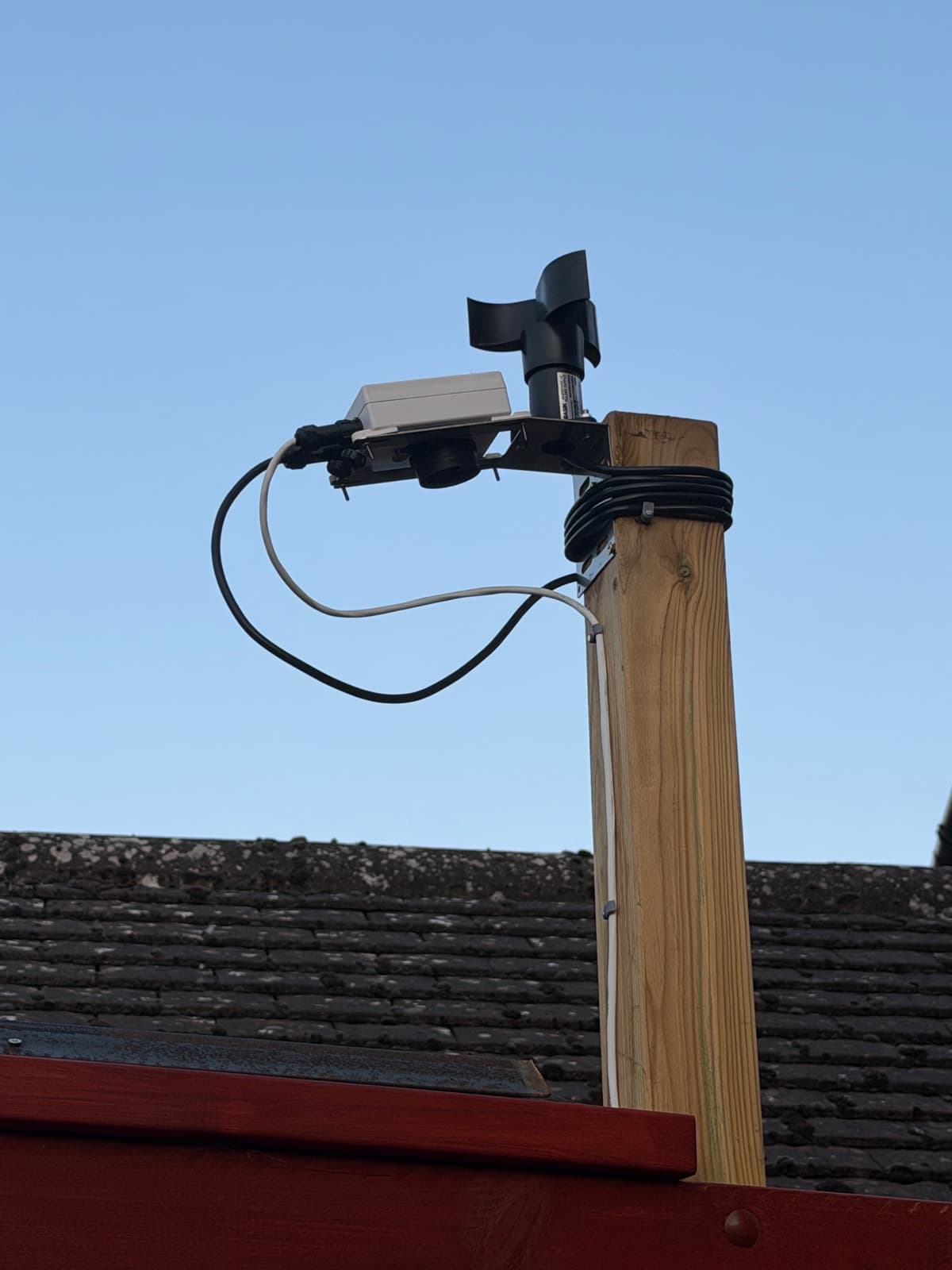
Lunatico CloudWatcher and Solo review: keeping an eye on the sky while we get on with life
Four months with the Lunatico CloudWatcher and Solo at the BeyondBackyard observatory: honest testing, one calibration hiccup, the limits of a dry British summer, and why we intend to buy the review kit.
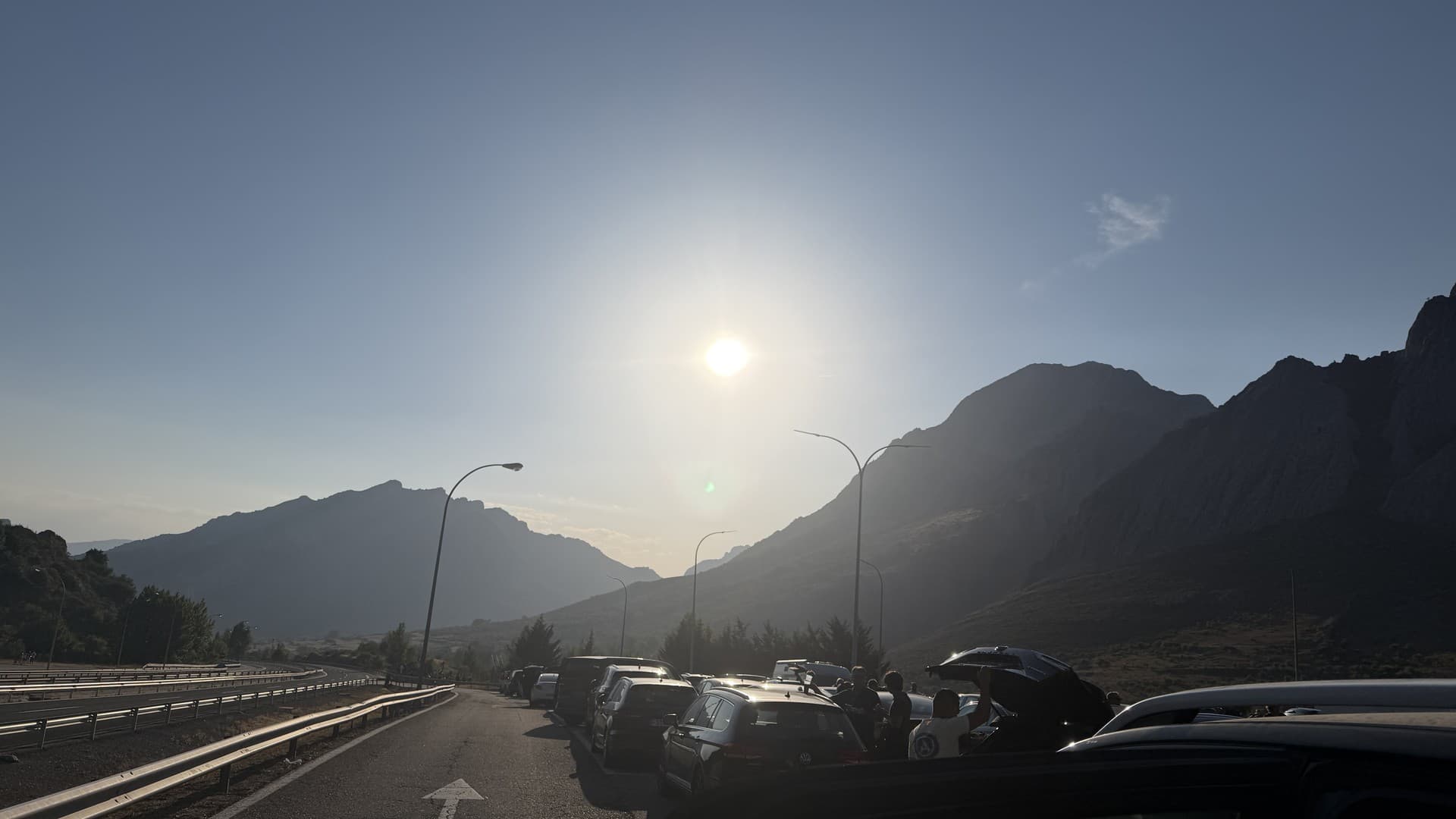
Chasing Totality: Our 2026 Eclipse Adventure in Spain
We chased a total solar eclipse across northern Spain, outran the clouds with minutes to spare, and learned that sometimes the best astrophotography equipment is the ability to stop fiddling with it.
Browse guides
Practical astrophotography tutorials.